

While offering unparalleled views and unforgettable experiences, journeys on F-roads pose significant challenges. Unlike paved highways or even typical gravel roads, conditions are rough, unpredictable, and often unforgiving. Drivers must understand that they bear full responsibility. Any miscalculation, such as misjudging a river crossing or underestimating a steep incline, can lead to delays, vehicle damage, or safety risks.
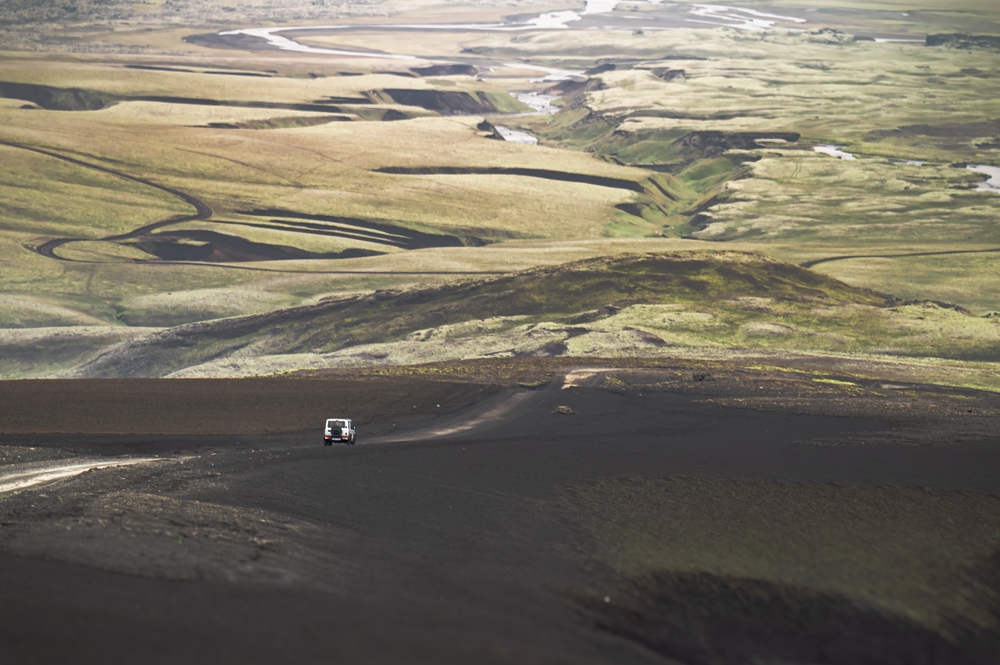
Iceland’s Highlands are among the country’s most spectacular and remote regions, characterized by expansive black sand deserts, geothermal valleys, vibrant rhyolite mountains, and vast glaciers. These remarkable areas are exclusively accessible via designated F-roads.
For those arranging a rental car in Iceland, it is crucial to recognize that exploring the Highlands demands heightened responsibility. These routes necessitate caution, thorough preparation, and respect for the natural environment. With careful planning and a clear awareness of potential risks, a Highland adventure can be both safe and profoundly rewarding. This guide offers a detailed overview to facilitate secure and well-prepared travel in the Highlands.
What Are F-Roads?
F-roads are classified as mountain roads, identified by the letter “F” preceding the route number (for example, F35 or F208). These are unpaved tracks leading into the Icelandic Highlands and are distinct from regular roads in several ways:
- They are unpaved and uneven, often consisting of gravel, loose stones, and steep gradients.
- They are seasonal, usually open only from mid-June to late September.
- They are demanding, with many requiring unbridged river crossings.
- By regulation, they are restricted to four-wheel drive vehicles.
Travel along F-roads is not intended for speed or convenience; rather, it is a slow and deliberate journey through challenging conditions. The reward, however, is access to Iceland’s most dramatic and untouched natural landscapes.
Vehicle Requirements for F-Roads
By law, only 4×4 vehicles are permitted on F-roads. Attempting to drive a two-wheel-drive car on these routes is prohibited and invalidates any insurance coverage. Furthermore, travelers must distinguish between different types of four-wheel drive vehicles.
It is important to note that not all 4x4s are identical. There is a significant difference between a standard 4×4 and a mountain vehicle. Mountain vehicles are heavily modified for the most extreme terrain and are not available within the Blue Car Rental fleet. Some F-roads remain beyond reach even for the most capable 4x4s in the fleet.
A vehicle that is legally permitted on F-roads is not necessarily suitable for every F-road. Travelers must select their vehicle according to the specific routes they plan to drive.