

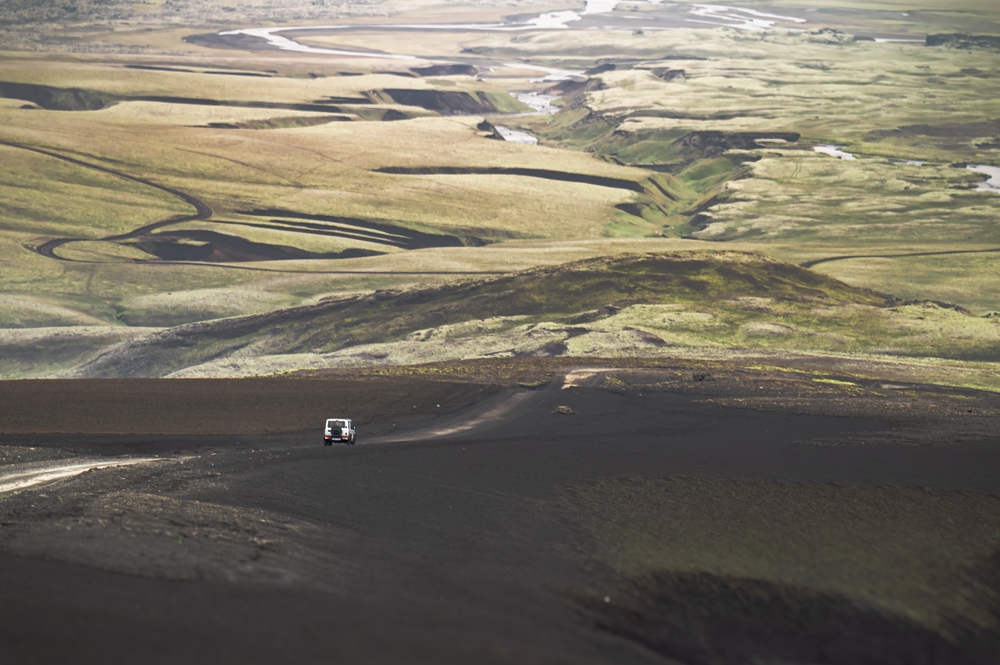
There’s paved Iceland, and then there’s the other Iceland. The Iceland above 500 metres, where the roads turn to gravel and rock, where rivers cross the route with no bridge, where the landscape looks like it belongs on another planet entirely. That Iceland is accessed via F-roads — and if you’re ready for them, they’ll be the highlight of your trip.
What Are F-Roads?
F-roads (the “F” stands for “fjallvegur” — mountain road) are Iceland’s highland tracks. They connect the remote interior, passing through the Highlands (Hálendið), which make up a vast, uninhabited plateau at the heart of the country. The most famous routes include:
- F35 (Kjölur Route): The most accessible highland route, running between Gullfoss and Akureyri. Passable in most 4×4 vehicles. No river crossings.
- F208 (Fjallabak via Landmannalaugar): Leads to the famous hot spring valley of Landmannalaugar, surrounded by rainbow-coloured rhyolite mountains. Multiple river crossings required.
- F210 (Mælifellssandur): Passes the striking Mælifell volcano cone rising from a black sand desert. Serious terrain.
- F26 (Sprengisandur Route): One of Iceland’s most remote routes, crossing a vast lava desert. Not for the faint-hearted or inexperienced.
When Are F-Roads Open?
F-roads are typically only open from late June to early September, depending on snowmelt. The exact opening dates vary year to year. You can check current road conditions and F-road status at road.is — this is essential reading before any highland trip.
Driving on a closed F-road is illegal and can result in significant fines. Beyond the legal risk, closed roads are closed for a reason — snow, flooding, and unstable ground can make them genuinely dangerous.
Do You Need a 4×4?
Yes. Without exception. F-roads require high clearance and four-wheel drive. Many also require the ability to ford rivers, which adds an extra layer of skill and risk. Driving a standard 2WD or low-clearance car on an F-road is both illegal and dangerous — you will get stuck, and the rescue teams (while excellent) are not free.
At Esja Car Rental, we offer 4×4 vehicles suitable for highland driving. If you’re planning a highland trip, just let us know and we’ll make sure you’re in the right vehicle.
River Crossings
Some F-roads cross rivers that have no bridges. This is one of the more serious aspects of highland driving in Iceland, and it deserves respect.
Before crossing any river:
- Walk it first on foot to check depth and bottom.
- Cross at the widest, shallowest point — never where it narrows.
- Remove your seatbelt before crossing so you can exit quickly if needed.
- Go slowly and steadily in low gear — don’t stop mid-crossing.
- Cross in convoy with other vehicles if possible. If one gets stuck, others can help.
- If in doubt, wait. Rivers are calmer in the morning than the afternoon (glacial melt peaks in the afternoon heat).
Leave No Trace
The Highland interior is an incredibly fragile ecosystem. Tyre tracks off-road can take decades to recover. Please stay on marked tracks at all times, pack out all waste, and leave the landscape exactly as you found it.
F-roads aren’t for every trip — but for those who are ready, they open up a side of Iceland that relatively few visitors ever see. Talk to us at Esja Car Rental if you’re planning a highland adventure and we’ll help you prepare properly.
Planning a highland adventure? Esja Car Rental has the 4×4 vehicles you need for Iceland’s mountain tracks. Browse our fleet and book your car →